
Abstract:
This study focuses on the examination of the impact of Justice Perception and Employee Empowerment on the Organizational Reputation in the projectized organizations (NGOs) in Pakistan. The role of Employee Perception on the relationships between Justice Perception and Organizational Reputation & Employee Empowerment and Organizational Reputation has also been studied. Non-Governmental Organizations (NGOs) working in Federally Administered Tribal Areas (FATA) and Frontier Regions (FR) of Pakistan were targeted, including the executives and managers of thirty Nongovernmental Organizations. The result revealed that justice perception has a positive and significant relationship with organizational reputation and also employee empowerment has a positive and significant relationship with organizational reputation. It has also been confirmed that employee perception positively moderates the relationships between justice perception and organizational reputation & employee empowerment and organizational reputation.
Key Words:
Non-Governmental Organization, Justice Perception, Employee Empowerment, Employee Perception, Frontier Regions, Temporary Displaced People, National Disaster Management Authority
Introduction
Recent organizational research has also investigated the role of a high reputation following negative events that have adverse financial, physical, or emotional consequences for an organization and its stakeholders (Pfarrer et al., 2008). Whereas some organizational scholars have theorized about reputation as general social approval of the organization, others have highlighted its multidimensional nature ( Rindova & Martins, 2012). Further, stakeholders’ expectations about appropriate conduct are higher for a high-reputation organization than for organizations without this asset (Mishina, Block, & Mannor, 2012). Industry rankings have been used widely in past organizational research to measure an organization’s general reputation (Mishina et al., 2010; Pfarrer et al., 2010).
In this study, an endeavor has been made to see how factors like justice perception, employee empowerment affect the reputation of a projectized organization and how employee perception influences the relationships between justice perception and organization reputation & employee empowerment and organizational reputation.
Literature Review
The empowerment of employees is directly related to the enhancement of the firm performance. Studies are available on how empowerment affects employee performance and organizational output but no study was found as to how it impacts the reputation of an organization. According to the literature, empowerment has many definitions each with a different perspective. Burke explained in 1986 that empowerment is the delegation of authority (Burke, 1986). Employee Perception is how an employee thinks about its organization as a whole. Better the perception higher will be the reputation.
Organizational Reputation
Recent organizational research has also investigated the role of a high reputation following negative events that have adverse financial, physical, or emotional consequences for an organization and its stakeholders (Pfarrer et al., 2008). Whereas some organizational scholars have theorized about reputation as general social approval of the organization, others have highlighted its multidimensional nature (Lange et al., 2011; Rindova & Martins, 2012). Further, stakeholders’ expectations about appropriate conduct are higher for a high-reputation organization than for organizations without this asset (Mishina, Block, & Mannor, 2012; Petkova et al.)
Justice Perception and Organizational Justice
Tyler and Lind (1988) in their research explored that a very less or little work has been done to uphold constancy of measurement. Greenberg (1993b) through research pointed out that many researchers is not giving any evidence or proof for using one item measure or ad hoc measure. In addition, Greenberg (1990b) also raise a point on the level of immaturity exist in organizational justice. The existence of immaturity is due to lack of standardized instrument in order to measure insights of distributive and procedural justice. Moreover, the instruments which are used for measurement are overwhelmed by the items which attempt to measure only one type of justice.
For instance, Gordon in his study used a different tool to measure distributive justice. It actually measures or assesses the ability to express ideas. Likewise, McFarlin (1997) used degrees of procedural justice in order to tap the outcomes. On the other hand, Joy through research asked people about the treatment which they received in the organization. It results in arousing issues related to interactional justice. These sorts of problem are commonly prevailing where interactional justice is the main concern.
Procedural Justice
The latest work on the processes of justice results in a decision known as procedural justice. The term procedural justice is cultivated via voice raising in the decision making process. It can also be nurtured through influence on the outcome or by sticking to the fair criteria for instance constancy, minimal level of prejudice, representation and accuracy.
Distributive Justice
Earlier most of the research has been done on the justice of decision outcome which is known as the distributive justice. It is cultivated when outcomes are linked with implied norms of allocation, for instance, equity or equality.
The existence of distributive justice prevails to the extent that the provision of an outcome is linked with the objective of a specific situation, for example, increasing the level of productivity or cultivating cooperation. One of the common goals in case of distributive justice is increasing the level of productivity. Most of the research has been done on the rules of equity. Leventhal (1976) in their research demonstrates the equity rule as a normative rule in which rewards and resources are distributed according to the contribution. Another researcher Deutsch (1975) also define the equity rule as the balance between rewards and inputs contribution of an individual.
Interactional Justice
The idea of interactional justice was first introduced by the Bies and Mong (1986) in their research work. The researchers identified four varied criteria for interactional justice. The base for identifying the criteria is the interpersonal treatment which an individual received during the recruitment process. The aforementioned criteria comprise of justification which demonstrates the basis for the decision. The second criteria are truthfulness which depicts an authority figure being open and not involved in practices like deception. Another criterion is respect which points out the polite aspect
The three dimensions mentioned in the study were overlapping with procedural justice criteria. Folger and Bies (1989) in their study points out that all the above-stated dimension or factor are by-product of the behaviour of decision-making authority. Moreover, the stated factors are also the product of structural aspect of formalized processes. However, ascribing the same standards for procedural and interactional justice results in creating drawback between the two types of justice. As a result of this practice, there is a high probability of correlation exist in procedural- interactional justice. The two successive section points out an empirical test for construct validity.
Employee Empowerment
The term empowerment get popularity in the early 1980s when it was called as employee involvement. The term derived from a number of fields for instance economy, psychology, education and organizational studies. In history, it can be defined as the giving power to an individual in an organizational role in order to improve the performance of the organization. In the case of empowerment, the power must be conferred to the individual or it should be a part of his or her administrative role. Researcher like Wetten and Cameron (1999) demonstrate in their research that the organization should have to give confidence to their employees. Moreover, the organization have to do something in order to overcome an individual feeling of inability and insufficiency. The idea of empowerment assumes that an individual doesn’t need only power. It also needs training, resources and information so that they become responsible for their every decision. Another researcher Lower (1996) and Foy (1997) in their study depicts that empowerment is more of delegating power. It means that employees can only be empowered when they have been given information, restructure the organizational structure and substituting hierarchies with team work. Theorist like Bandura and Lower explained the empowerment factor in the context of motivation. In addition to, it also increase the self-efficacy. Conger and Thomas theory of empowerment linked motivation with increased duties. It also involves three other factors which includes self-determination, impact and meaningfulness. In later times, Cameron in view of aforementioned factors also add another factor which is trust. The investigative study of Velthouse (1990) and Speritzer brought the importance factor of empowerment. According to this study, the competence of employees will not be optimum unless employees are not psychologically ready to accept empowerment.
H1: Justice Perception has a positive and significant effect on Organizational Reputation.
H2: Employee Empowerment has a positive and significant effect on Organizational Reputation.
H3: Justice Perception significantly effects organizational reputation through employee perception.
H4: Employee Empowerment significantly affect organizational reputation through employee perception.
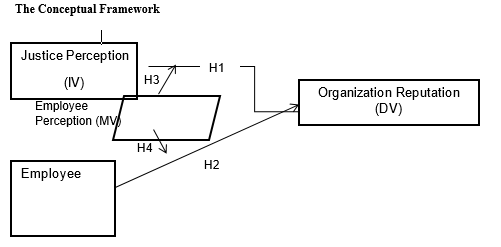
Methodology and Data Analysis
The purpose of this research is to determine what impact the justice perception and empowerment of employees will have on organizational reputation while taking into account the moderating effect of employee perception about their organization. Based on survey questioner data was collected from 30 Non-Government Organizations (NGOs) working for relief and assistance of Internally Displaced Persons of Pakistan. The analysis of collected data was done using SPSS version 21 (software) through regression and correlation analysis. The final results of the hypothesis have been summarized at the end.
Table 1.
| Category width="80">Type width="79">Frequency width="79">Percentage width="54">Mean width="104">Std. Deviation | > Gender width="80">Male width="79">239 width="79">79.7 width="54" rowspan="2">1.2 width="104" rowspan="2">0.403 | > Female width="79" valign="top">61 width="79" valign="top">20.3 | > Age width="80" valign="top">20-25 years width="79" valign="top">42 width="79" valign="top">14 width="54" rowspan="4" valign="top">33 width="104" rowspan="4" valign="top">1.03 | > 26-35 years width="79" valign="top">139 width="79" valign="top">46.3 | > 36-40 years width="79" valign="top">56 width="79" valign="top">18.7 | > >41 years width="79" valign="top">63 width="79" valign="top">21 | > Experience width="80" valign="top">1-5 years width="79" valign="top">96 width="79" valign="top">32 width="54" rowspan="4" valign="top">8.48 width="104" rowspan="4" valign="top">1.03 | > 6-10 years width="79" valign="top">110 width="79" valign="top">36.7 | > 11-15 years width="79" valign="top">42 width="79" valign="top">14 | > >16 width="79" valign="top">52 width="79" valign="top">17.3 | > Education width="80" valign="top">Intermediate width="79" valign="top">10 width="79" valign="top">3.3 width="54" rowspan="3" valign="top">15.52 width="104" rowspan="3" valign="top">0.48 | > Bachelor width="79" valign="top">42 width="79" valign="top">14 | > Masters width="79" valign="top">248 width="79" valign="top">82.7 |
(Number of Respondents, N = 300)
Above Table shows that there werenumber of male respondents (79.7%) than female respondents (20.3%), most of the respondents have ages between 30 to 40 years of age (mean value 33 years). The respondents had generally adequate experience of serving in NGOs (mean value 8.48 years) and were mostly well qualified with 82.7% having master level education.
The sample consisted of 30 national Non-Governmental Organizations (NGOs) selected on the basis of having more than 3 years of experience in relief activities. 10 respondents were selected from each NGO. To select a homogeneous group having representatives from all classes 2 respondents were from Board of Directors, 2 from Executive Group, 2 from Managerial Group, 2 from Field Worker Group, 2 from Office Staff. Representation of respondents from each NGO was therefore 3.33% of the sample size.
Table 2. Descriptive Statistics of Study Variable
| Variables width="40">N width="37">Min width="38">Max width="45">Mean width="67">Std. Deviation width="67">Skewness width="61">Kurtosis | > Justice Perception width="40" valign="top">300 width="37" valign="top">1.55 width="38" valign="top">4.95 width="45" valign="top">4.05 width="67" valign="top">0.576 width="67" valign="top">-0.906 width="61" valign="top">0.798 | > Employee Empowerment width="40" valign="top">300 width="37" valign="top">2.40 width="38" valign="top">5.00 width="45" valign="top">4.0 width="67" valign="top">0.577 width="67" valign="top">-0.386 width="61" valign="top">-0.356 | > Employee Perception width="40" valign="top">300 width="37" valign="top">2.32 width="38" valign="top">4.95 width="45" valign="top">4.21 width="67" valign="top">0.529 width="67" valign="top">-0.521 width="61" valign="top">0.617 | > Organizational Reputation width="40" valign="top">300 width="37" valign="top">2.35 width="38" valign="top">5.00 width="45" valign="top">4.42 width="67" valign="top">0.494 width="67" valign="top">-1.268 width="61" valign="top">1.809 |
(Number of Respondents, N = 300)
Above Table shows valid number of respondents, N = 300 for all variables. The mean values (4 to 4.42) shows that the respondents have generally very highly graded items of all variables, which means that most of the employees working in NGOs believe that they are dealt with justice, are sufficiently empowered, have a positive perception of their organization and thus in-turn believe that their organization is well reputed. The values of skewness (reference range -2 to +2) and kurtosis (reference range -3 to +3) are within the acceptable range which means that the data of all study variables is normally distributed.
Table 3. Reliability Check of Study Variables
| Name of Variable width="214">Cronbach’s Alpha | > Justice Perception width="214">0.911 | > Employee Empowerment width="214">0.861 | > Employee Perception width="214">0.881 | > Organization Reputation width="214">0.925 |
The table shows that the Cronbach’s Alpha values of all variables are well within the desirable value of 0.6, which confirms the reliability of measures adopted for this research.
Table 4. Pearson Correlation Matrix
| S/ No width="150">Variable Name width="51">I width="54">II width="51">III width="101">IV | > I width="150">Justice Perception width="51">1 width="54">width="51"> width="101">
| > II width="150">Employee Empowerment width="51">0.556* width="54">1 width="51">width="101">
| > III width="150">Employee Perception width="51">0.673* width="54">0.589* width="51">1 width="101">
| > IV width="150">Organization Reputation width="51">0.627* width="54">0.541* width="51">0.771* width="101">1 |
*Correlation is significant at the level 0.01 (2-tailed)
The matrix shows that a positive and significant relationship holds between Justice Perception, Employee Empowerment, Employee Perception and Organization Reputation at a significance level (p) of 0.01 or 1% for a two-tailed test. The value of “r” which can range between -1 to +1 shows that a strong positive relationship (r=0.771) exists between Employee Perception and Organization reputation whereas, a moderately positive relationship exists between Justice Perception and Employee Perception (r=0.673) and between Justice Perception and Organization Reputation (r=0.627). Similarly, a moderately weak and positive relationship exists; between Justice Perception and Employee Empowerment (r=0.556), between Employee Empowerment and Employee Perception (r=0.589) as well as between Employee Empowerment and Organization Reputation.
Table 5. Regression Analysis
| Model width="41" rowspan="2">R2 width="112" colspan="2">Un-Standardized Coefficients width="106" rowspan="2">Standardized Beta Coefficient (?) width="35" rowspan="2">Sig | > B width="71">SE | > Justice Perception - Organization Reputation width="41">.393 width="41">.537 width="71">.039 width="106">.627 width="35">.00 | > Employee Empowerment - Organization Reputation width="41">.290 width="41">.48 width="71">.043 width="106">.541 width="35">.00 | > Justice Perception - Organization Reputation with moderator Employee Perception width="41">.569 width="41">.092 width="71">.005 width="106">.754 width="35">.00 | > Employee Empowerment - Organization Reputation with moderator Employee Perception width="41">.527 width="41">.093 width="71">.005 width="106">.726 width="35">.00 |
Level of Significance, p< 0.05
The table shows the summarized results of regression analysis the value of R2 is the value of the coefficient of determination which explains how much percentage of variation in Dependent Variable (Organization Reputation) is explained by variation in Independent Variables (Justice Perception, Employee Empowerment). The unstandardized beta value shows the average change in the dependent variable due to a unit change in the dependent variable while statistically controlling for the independent variable. The standardized beta coefficient (?) shows, by how many standard deviations the dependant variable change per standard deviation change in the independent variable. In simple linear regression analysis the regression equation is expressed as (y1 = ? + ?i xi), the value of “?” will therefore determine the strength and direction of the relationship.
The table shows that at p<0.05 significant and positive relationship exists between Justice Perception and Organization Reputation the value of R2 = .39 shows that 39% variation in organization reputation is explained by variation in justice perception, the value of ? = .627 shows that variation in justice perception will change organization reputation by .627 times. Similarly, a significant and positive relationship was found between Employee Empowerment and Organization Reputation the value of R2 = .29 shows that 29% variation in organization reputation is explained by variation in employee empowerment, the value of ? = .541 shows that variation in justice perception will change organization reputation by .541 times. These findings confirmed the first two hypothesis H1 and H2.
The similar regression models in cooperating the effect of moderating variable of Employee Perception show, Justice Perception to be positively and significantly linked to Organization Reputation (? = .754, p<0.05) and Employee Empowerment to be positively and significantly linked to Organization Reputation (? = .726, p<0.05). These findings confirmed the last two hypothesis H3 and H4.
Table 6. Summary of Results of Hypothesis Testing
| Hypotheses width="114">Path as per Theoretical Framework width="49">? width="56">R2 width="91">Significance width="81">Result | > H1 width="114" valign="top">Justice Perception à Organization Reputation width="49" valign="top">.627 width="56" valign="top">.393 width="91" valign="top">P<.05 ; significant width="81" valign="top">Accepted | > H2 width="114" valign="top">Employee Empowerment à Organization Reputation width="49" valign="top">.54 width="56" valign="top">.29 width="91" valign="top">P<.05 ; significant width="81" valign="top">Accepted | > H3 width="114" valign="top">Justice Perception à Organization Reputation with moderator Employee Perception width="49" valign="top">.754 width="56" valign="top">.56 width="91" valign="top">P< .05; significant width="81" valign="top">Accepted | > H4 width="114" valign="top">Employee Empowerment à Organization Reputation with moderator Employee Perception width="49" valign="top">.72 width="56" valign="top">.52 width="91" valign="top">P< .05; significant width="81" valign="top">Accepted |
Conclusion
In this study main focus was to examine the impact of justice perception on organizational reputation and also the impact of employee empowerment on organizational reputation. The moderating role of employee perception on both the above-mentioned relationships i.e. the relationship between justice perception and organizational reputation & relationship between employee empowerment and organizational reputation has also been examined. The results reveal that justice perception has a positive and significant relationship with organizational reputation and employee empowerment has a positive and significant relationship with an organizational reputation in projectized organizations (NGOs) working in Pakistan. It has also been confirmed in this study that employee perception has a moderating effect on the relationship between justice perception and organizational reputation and it also has a moderating effect on the relationship between employee empowerment and organizational reputation. The establishment of this relationship is an addition in the literature which will be very useful for future researchers.
References
- Ambrose. (2001). A Contented Analysis of the Content Analysis Literature in Organization Studies: Research Themes, 12(2): 5- 36.
- Aquino. (1995). An Introduction to Qualitative Research. Thousand Oaks, CA, Sage Publications.
- Balmer. (2001). The Role of Entrepreneurial Orientation in Stimulating Effective Corporate Entrepreneurship. Academy of Management Executive, 19(1), 147-156.
- Barich & Kotler. (1991). Small and Medium Enterprises across the Globe. Small Business Economics 59(1): 315-234.
- Barling. (1990). Empowerment as the process of increasing self-efficacy 21(1): 43-57.
- Bartol. (1997). Entrepreneurship: Theory. Process. Practice. Thompson Learning
- Berens & van Rieel (2004). Unidimensional Measurement and Structural Equation Models with Latent Variables. Journal of Business Research, 11 (4), 437-342.
- Berens & van Riel. (2004). Applied Business Research: Qualitative and Quantitative Methods, John Wiley & Sons Australia, Ltd. Cavusgil, S. T. Chun (2005).
- Berens & van Riel. (2004). Contains items asking whether supervisor considered employee viewpoint. 16(4): 287-298.
- Berens & van Riel. (2004[1993]). Time and Entrepreneurial Risk Behavior. Entrepreneurship Theory and Practice, 23(3), 39-48.
- Bickerton. (2000). Entrepreneurial Orientation: Assessing the Constructs Validity and Addressing Some of Its Implications for Research in the Areas of Family Business and Organizational Learning. Entrepreneurship: Theory & Practice, 25(4), 1067- 1090.
- Carter & Deephouse (1999); Bromley (2001) Profile of SMEs and SME Issues in APEC 1990-2000. Singapore, APEC Secretary.
- Carter and Deephouse. (1999). Entrepreneurial Orientation of SMEs, Product Innovativeness, and Performance. Journal of Business Research. 62(3), 536- 585.
- Caruana. (1997). Local Cluster in Global Value Chains: A Case Study of Wood Furniture in Central Java (Indonesia). Department of Spatial Economics, Vrije Universiteit Amsterdam (VU). PhD Thesis
- Deutch. (1975). Culture and Entrepreneurial Orientation: a Multi-Country Study. International Entrepreneurship and Management Journal 8(2): 1-25.
- Donovon. (1986). A detail empirical test of the construct validity of justice 19: 120-242.
- Dowling. (1993). Non-Financial Performance Measurement in Manufacturing Companies. The British Accounting Assessment 31(3): 241-268.
- Dowling. (2004). Practical Research Methods: A User-friendly Guide to Matering Research Techniques and Projects. Oxford, How to Books Ltd.
- Dukerich and Carter (2000) Strategy: Indonesian Furniture and Craft Industry.
- Fombrun & Shanley. (1990). A Theoretical Methodology of Entrepreneurial Orientation within Small Business Context. Journal of Enterprising Culture. 11(3): 23-75.
- Fombrun & Shanley. (1990). Translation and Content Analysis of Oral and Written Materials. Handbook of Cross-Cultural Psychology. H. C. Triandis and J. W. Berry. Boston, Allyn & Bacon. 2: 350-254.
- Fombrun, G. & Sever. (2000). SPSS Version 17.0 for Windows: Analysis without Anguish.
- Fombrun. (1995). The Moderating Effect of Environmental Variables on the Entrepreneurial and Marketing Orientation of Entrepreneur-led Firms. Entrepreneurship: Theory and Practice. 24(3): 37-68.
- Fombun. (1996). Diagnosing and changing organizational culture. Addison- Wesley: Massachusetts
- Fryxell & Gordon. (1989). An Operationalization of Stevenson's Conceptualization of Entrepreneurship as Opportunity-Based Firm Behavior. Strategic Management Journal. 12(9), 753-928.
- Fryxell & Wang. (1994). Small and Medium Enterprise Dynamics in Indonesia. Bulletin of Indonesian Economic Studies 37(3): 273-184.
- Fryxell & Wang. (1994). The Landscape of Qualitative Research. CA: Sage Publications
- Fukuyama. (1995). Strategic Process Effects on the Entrepreneurial Orientation-Sales Growth Rate Relationship. Entrepreneurship Theory and Practice, 29(4), 56-81.
- Gotsi & Wilson. (2001). Correlation Between procedural justice and distributive justice: A Systematic Review of the Literature from 1997-2003. Technovation 16(4-5): 654- 364.
- Gotsi & Wilson. (2001). Innovation, Collaboration and SMEs Internal Research Capacities. Research Policy. 31(5), 735-747.
- Gotsi & Wilson. (2001). Structural Equation Modeling in Practice: A Review and Recommended Two-Step Approach. Psychological Bulletin, 107(3), 421-123.
- Gotsi & Wilson. (2001). The Financial Crisis and the Gathering of Political Intelligence: A Cross-country Comparison of SMEs in France, Sweden and the U.K. International Small Business Journal. 50(4), 245-376.
- Hatch & Schultz. (2003). Entrepreneurial Strategy Making and Firm Performance: Tests of Contingency and Configurational Models. Strategic Management Journal, 18(9), 677-695.
- Helm. (2005). Basic Marketing Research, South-Western Cengage Learning.
- Herand, M. (1995). A Method of Analyzing Interview Transcripts in Qualitative Research. Nurse Education Today, 12: 361-446.
- Hobbes. (1995). Researching the Small Enterprise. London, Thousand Oaks, New Delhi, Sage Publications.
- Latham. (1997). The Overestimated Role of Strategic Orientations for International Performance in Smaller Firms. Journal of International Entrepreneurship 7: 57- 77
- Leventhal. (1976). Doing Business Research: Theory and Practice. London, California, New Delhi, Singapore, Sage Publications.
- Lind & Tyler. (1988). Autonomy and Innovativeness: Understanding Their Relationships with Performance of Indonesian SMEs. The Joint ACERE-DIANA International Entrepreneurship Conference
- Lind & Tyler. (1988). The Role of Institutional Environment in Determining Firm Orientations towards Entrepreneurial Behavior. International Entrepreneurship Management Journal , 4(4), 457-383.
- Lind. (1995). Internal Capabilities, External Networks, and Performance: A Study on Technology-Based Ventures. Strategic Management Journal, 21(5/6), 625-640.
- Lower & Foy. et. al. (1997). Introduction to the Special Issue on Qualitative Methods in Entrepreneurship Research. Journal of Business Venturing 17(5): 387-395.
- Martocchio. (1997). Cross-Cultural Differences in Survey Response Patterns. International Marketing Review 24(2): 127-143.
- McFarlin. (1997). Missing the Boat and Sinking The Boat: A Conceptual Model of Entrepreneurial Risk. Journal of Marketing, 51(2), 59-71.
- McFarlin. (1997). Overlap with the procedural justice
- Moorman. (1991). Western Perspectives on Entrepreneurships and Their Sensitivity in the Context of Asian Cultures. International Journal of Entrepreneurship and Small Business, 14(4), 534-247.
- Newell & Goldsmith. (2001). Interview Studies in International Business Research. Handbook of Qualitative Research Methods for International Business. R. Marschan-Piekkari and C. L. Welch. Cheltenham, Edward Elgar: 175-216.
- Nooteboom, B.N. (1997). Research on Innovation in Organizations: Distinguishing Innovation-Generating from Innovation-Adopting Organizations. Journal of Engineering and Technology Management, 24(3), 259-281.
- Prehar. (1999). Introduction to Entrepreneurship. Canada, South-Western Cengage Learning.
- Rao. (1994). Scale Development: Theory and Applications. Thousand Oaks, CA, Sage Publications.
- Rao. (1994). Structural Equation Modeling Using AMOS 6.0. Melbourne, Swinburn University of Technology.
- Schultz, H. & Holten, L. (2000). A Critical Examination of the EO-Performance Relationship. International Journal of Entrepreneurial Behaviour & Research. 10(6), 319 - 428
- Sok, P., & O'Cass, A. (2015). Achieving service quality through service innovation exploration - exploitation: the critical role of employee empowerment and slack resources. J. Services Marketing, 29(2), 137-149.
- Stein. (2003). The Role Of Entrepreneurial Orientation on Firm Performance and the Potential Influence of Relational Dynamism. Journal of Global Business and Technology. 6(2), 28-39
- Stuart. (1990). Handbook of Qualitative Research. Thousand Oaks, CA, Sage Publications.
- Tata & Bowes. (1996). The Process of giving power from the tradionally powerful manager in an organization. 10(2): 31-29.
- Thevissen. (2002). Diagnosing and changing organizational culture: Based on the competing values framework.
- Thibaut & walker. (1975). The Adoption of Radical and Incremental Innovations: An Empirical Analysis. Management Science, 32(11), 1422-1433.
- Tyler & Lind. (1988). The Qualitative Contented Breakdown Process.
- Welbourne & Balkin. (1995). Small Business Growth: Recent Evidence and New Directions. International Journal of Entrepreneurial Behavior & Research, 13(5): 296-322.
Cite this article
-
APA : Iqbal, Z., Rehman, M. Z., & Hassan, N. (2016). Organizational Reputation as Economic Strength: Role of Justice Perception and Empowerment. Global Economics Review, I(I), 66-76. https://doi.org/10.31703/ger.2016(I-I).07
-
CHICAGO : Iqbal, Zafar, Muhammad Zia-ur Rehman, and Noor Hassan. 2016. "Organizational Reputation as Economic Strength: Role of Justice Perception and Empowerment." Global Economics Review, I (I): 66-76 doi: 10.31703/ger.2016(I-I).07
-
HARVARD : IQBAL, Z., REHMAN, M. Z. & HASSAN, N. 2016. Organizational Reputation as Economic Strength: Role of Justice Perception and Empowerment. Global Economics Review, I, 66-76.
-
MHRA : Iqbal, Zafar, Muhammad Zia-ur Rehman, and Noor Hassan. 2016. "Organizational Reputation as Economic Strength: Role of Justice Perception and Empowerment." Global Economics Review, I: 66-76
-
MLA : Iqbal, Zafar, Muhammad Zia-ur Rehman, and Noor Hassan. "Organizational Reputation as Economic Strength: Role of Justice Perception and Empowerment." Global Economics Review, I.I (2016): 66-76 Print.
-
OXFORD : Iqbal, Zafar, Rehman, Muhammad Zia-ur, and Hassan, Noor (2016), "Organizational Reputation as Economic Strength: Role of Justice Perception and Empowerment", Global Economics Review, I (I), 66-76
-
TURABIAN : Iqbal, Zafar, Muhammad Zia-ur Rehman, and Noor Hassan. "Organizational Reputation as Economic Strength: Role of Justice Perception and Empowerment." Global Economics Review I, no. I (2016): 66-76. https://doi.org/10.31703/ger.2016(I-I).07